

Oxford, November 2018. Article as featured on The Huffington Post Young Voices Blog.
Last winter the Ashmolean Museum of Art and Archaeology were the hosts of a Children in Need funded project run by Oxford Fusion Arts and Art Psychotherapist, Helen Edwards. The 12 week project saw 30 children from three local Oxford primary schools come to the museum. All the children had been selected for extra support with anxiety and communication difficulties. A number of museum staff from the Ashmolean also took part in the project. I spoke with one of them: Clare Coleman, Sackler Education Officer Early Years to KS2 at the Ashmolean. Clare, as well as being an incredible children’s educator is also an extraordinarily intelligent and lovely lady, and a superb sculptor. She is also my auntie!
Could you start from the beginning and explain the process of the project?
The project spanned across winter 2017/18 with a Christmas break in the middle. There were three visits to the museum included in the project and lots of extra creative work completed at the children’s schools in between visits.
When the children came to the museum for the first day of the project many were nervous. Fusion Arts volunteers alongside myself and local violin maker Bruno Gaustalla were ready and waiting to welcome the children. An icebreaker activity helped make the children feel comfortable and get to know each other. As the project is all about creating stories we began by making ‘story friends’. All the adults and children made their own story friend and decided how it spoke and moved. We then introduced our story friends to everyone. Many of the children would usually find introducing themselves daunting but introducing their story friend was much easier for them. The spotlight and associated anxiety was deflected from them to their story friend and adults and children were behaving as equals.
The next step for us all was to visit the museum’s Music Gallery. We looked at the huge array of stringed instruments and discussed how fascinating it is that musical instrument making has not changed for many centuries – they are still made in a very similar way to this day.
After exploring the galleries, everyone was asked to sit or lie down – if they wanted – on the floor of the gallery. The public were still able to access the peripheries of the space but it was the kids who were in control. I made a connection with one boy who wanted to sit down with me. Bruno sat down with his cello and played. He asked the kids about what emotions they were feeling and decided to play them. We lay down listening whilst the children made their story friends dance or relax or do whatever they wanted. It was a wonderful experience, interactive and heartwarming.
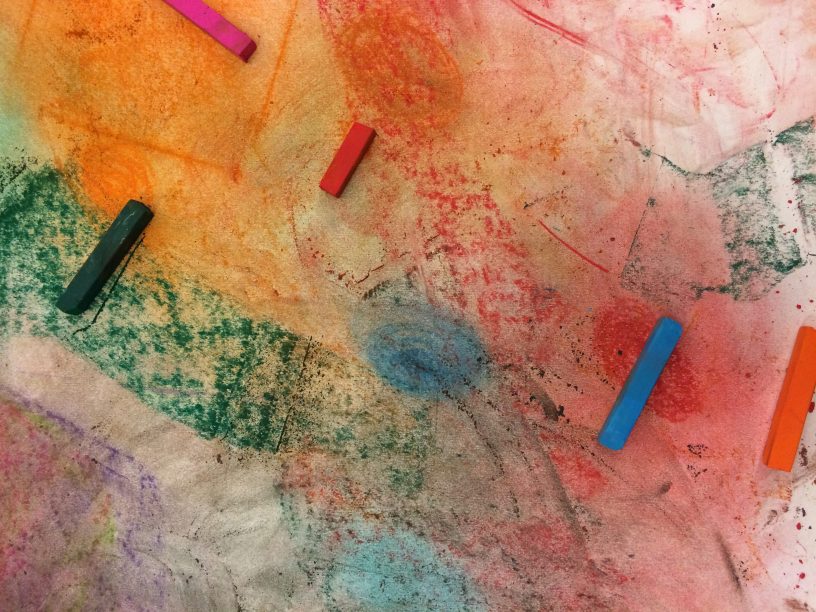
Later that day we moved to the museum’s education studios and we got very messy with pastels. We filled the paper with what we thought the sounds of Bruno’s cello would look like. You can imagine the huge variety of impressions, it was very open ended.
Between the 1st and 2nd visits the children created a lot of material in school sessions including 40+ canvases which filled an entire wall at the Ashmolean. In fact, everyone involved in the project made a canvas.
On the 2nd visit, we went up into our European Art gallery which has a harpsichord amongst other things. Arne Richards, who plays harpsichord regularly for the public in the gallery played for the Story Makers. We all chose flamboyant fancy dress clothing and danced in time with the music with peacock feathers. We interacted by looking at each other, by gesture and by passing the feather back and forth. Normally we’re not allowed to bring long sticks into galleries but a welcome exception was made for the feathers.
The project culminated in a celebration event during museum hours in early spring. The children and all who were involved in the project were joined in the public galleries where artwork the children had completed was displayed. 150 members of the public joined the celebration.
What were some of the outcomes for the children?
One mother spoke to me about her son and told me how before the project he had been terribly anxious. He was anxious about life, the universe, literally everything – even the rain. But not anymore! Every week he had become a little less anxious and as we observed him on celebration day we saw him proudly leading his cousin around the exhibition showing what he had made without anxiety.
Also, there was a girl who danced with me during the harpsichord session in the galleries. She had been non-verbal for some years but made strong visual connection during the dance and participated fully in the project. Come celebration day I was astonished when she came in, sat down next to me and said “Hello, Clare, this is my sister”. I was thinking, “wow, you’re talking… this is amazing!!” That was very powerful for me – that I had played a very small part in that child finding her voice was absolutely incredible.
As you can imagine there were many more positive outcome for the children and for their parents, and well, for everyone involved in the project. I remember fondly when one of the fathers made a beautiful weaving using a technique he learnt from his home country and presented it as a gift to Helen.
How did the young storytellers presence in the museum, and their work, affect and influence museum staff and the public?
During one of the dance sessions in the public galleries there was a group of young foreign exchange students who were absolutely fascinated by what was going on and decided to sit at the edge of the space and watch the whole session. They were all smiling and so happy to see such an interactive and interesting spectacle unfolding in front of their eyes.
During another session one lady exclaimed “Oh my goodness it’s like walking into a party. What a wonderful project!”
Can you explain a little more about how barriers were overcome during the project?
I think the importance of the project relied on how open and creative the activities were and that the children were not forced to do anything that they didn’t want to. There were no barriers as the children could respond in their own way. For example, when we were dancing with peacock feathers to the sounds of the harpsichord one girl who didn’t want to dance, and of course she didn’t have to. She just wanted to have a very close look at Arne playing the harpsichord. She was interested in how the harpsichord worked. Humans are not all interested in the same things. Best practice is to be aware that anxieties might make a child reluctant to do a particular thing.
Why is this type of programme not available for all school children across the country?
Unfortunately, yet predictably it’s about lack of funding. As museum professionals, what we can do is ensure our museums are open, welcoming spaces for children. Maybe a child with ADHD can’t sit still which affects his education in a school classroom however she might not need to sit at all whilst learning in a museum space.
We always make sure that the kids have something to touch. Whenever you allow people to actually get hands on, it allows them to engage with objects in different ways, and get different responses. However if they elect not to touch, that is also fine.
Are museums changing to embrace more projects like this one?
There is definitely an appetite for change – from other colleagues around the world. This year I spoke at the 11th International Conference of The Inclusive Museum in Granada, Spain. I spoke about facilitating engagement with visually impaired kids in mainstream schools. It was extremely interesting to meet other museum educators from around the world and discuss diverse ideas. One discussion focused on how people who are visually impaired enjoy things in different ways and the importance of increasing low tech interventions in museums to assist visitors, be they visually impaired or not, allowing all people to enjoy collections and buildings in different ways.
What was the legacy of the project?
Everyone felt so valued and had a great experience. The director of the museum also came down to address the final celebration whilst the exhibition was displayed for the public to enjoy for 3 months. The project had built strongly on other public facing projects, which have been something the museum has been increasing and improving strongly upon since it was reopened after a huge redevelopment project in 2009.
The project allowed Arts Psychotherapist, Helen Edwards to find, as she has been doing every year since the programmes inception in 2010, a way of making some changes that could go back to the teachers at school to help them better connect and teach the children in different ways.
For the children, the legacy is huge. As discussed some have become less anxious, have found their voice and have become more confident. The project really played on the idea of the children just being allowed to be human – to connect, dance, interact with each other and enjoy themselves. It was absolutely magical to see their faces when they saw their work up in the museum. As well as work continuing in the school after the project, the children each received a small book containing the brilliant stories they had written.
The stories were extremely inventive. Some profound. The following is the story from a little girl who was fighting her fears through her work during the project. She was not told what to write about in her story, it was all her own.
When I went into the jungle I wandered off and met a tiger. The tiger roared at me and I was scared. I knew I could be brave and I wanted to be braver. I said “Hi, I am Helgar”. The tiger roared again. I stood still and roared at the tiger. It could see that I was brave. We roared at each other and I realised that I could be a tiger.
For the next installment of the fantastic Story Makers project, Fusion Arts are taking local school children to the University of Oxford Botanic Garden.

 The Bowden Report