
Alicante, Spain, Dec 2018
My alarm sounds at 6.30, I get up, make my bed, walk to the kitchen patio and flip the switch turning the gas tank on. It is December and although it will be warm enough to wear a t-shirt later in the day, my house is freezing cold. Central heating in Alicante is rare and the stone floor turns the apartment into a 60m² freezer. I shower quickly with the portable heater in the bathroom on full power so as not to catch a cold. I get dressed and walk briskly to a fellow teacher’s house who kindly takes me to school most mornings.
We’re off, ascending out of the city in her van, up through the foothills and between the forested mountains of the Parque Natural de la Sierra de Mariola. It’s a commute of the senses, with a daily sunrise painting the sky above the mountains and the Mediterranean with golds, pinks and purples. My eardrums acclimatize to the pressure as we climb from sea level up to IES La Creueta, the high school where we work, which sits at a modest 700 metres above sea level. We are surrounded on three sides by mountains of 1200m. Stepping out of the car my body is hit with a temperature 5 or 6 degrees lower than when we set off 30 minutes earlier. Low, wispy clouds hang effortlessly below us and around the castle of neighbouring town Castalla. We enter the school’s cafe for coffee and tomatoes on toast. It’s 8am, my senses are alive and I haven’t even begun teaching for the day.
My first class of the day is with students studying a professional qualification in Environmental and conservation studies. We work on English grammar exercises with a leaning towards vocabulary around the science, management techniques and professional careers associated with the environment, particularly the forest. The students are of all ages ranging from 16 to middle aged adults. As well as English, the students learn tree surgery, forest management, including fire usage (prescribed burning), prevention, beekeeping, climbing and hiking outdoors.
After the environmental and conservation studies class it is my turn to get physical. I take a mountain bike from the school’s bike store and make my way back down the mountain. I do this each working day and it is wonderful. A ten minute – twenty on the return journey – cycle down country roads past farm houses and olive groves, dodging tumbleweeds on windy days and being grateful for the fresh breezes which keep the summer heat and the deceivingly freezing winter humidity away. Throughout my short trip I watch, and I am watched, by the imposing castle of Castalla which has been a constant fixture in the area in one way or another since the first fortifications were built by the Moors around 1000 years ago.
Continuing my descent I pass an old man of at least 80 years yet walking uphill with vigour. He looks up with glee and shouts “Bon Dia!” Good morning in Valenciano, the local dialect – a mix of Spanish and French with a touch of Italian. I return the greeting. I feel like I have come home. I am originally from a small countryside village in Suffolk on the east coast of England but for the past ten years I have lived in cities: Hull; Liverpool; London; Valladolid; Alicante. Now, I am reminded again, not that I needed to be, how comfortable I feel in this countryside environment. Everything moves slower and people are not as caught up in the hustle and bustle that comes with life in the city.
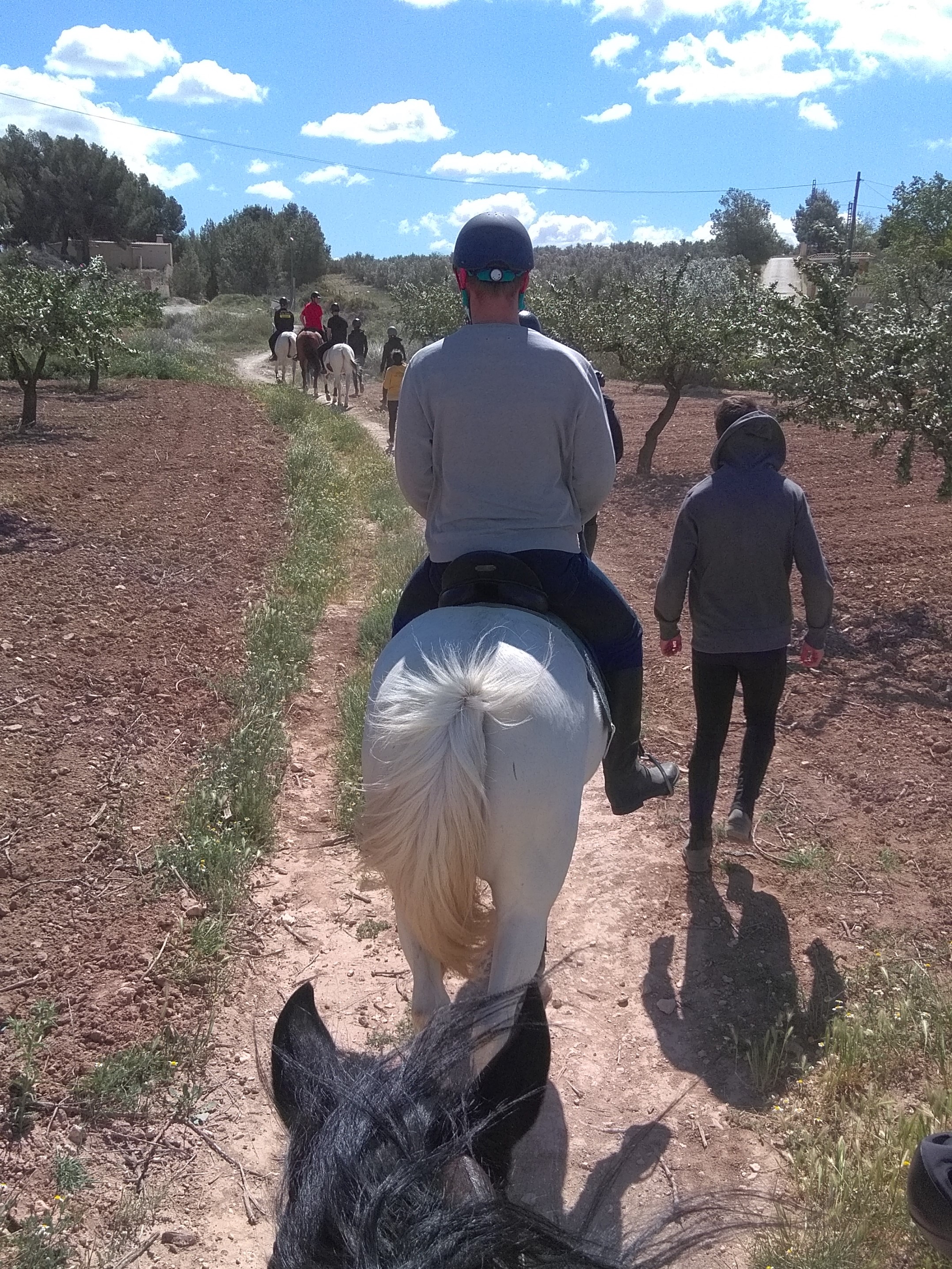
4km later and on reaching a flatter part of the valley known as La Foia de Castalla, I reach my destination where the majority of my lessons take place. I teach in a hípica (horse-riding centre). Home to over twenty beautiful horses, small and large training tracks and other facilities including two classrooms. The students come from the high school to study equestrian studies once a week as part of their professional qualification in physical education in the natural environment. As well as equestrianism and horse care they study, and practice: small business administration, management and marketing; biology, health, nutrition and first aid; physical activities for people with disabilities; group dynamics; and cycling, climbing, team sports and orienteering.
Similarly to the students studying environmental and conservation studies, I tailored the lessons at the riding school to be of relevance to the student’s equestrian studies. Some of the key areas of our lessons include customer service training, being able to explain rules and commands, the science and history of horse riding and human’s relationships with horses and an ongoing development of horse and tourist industry vocabulary.
The learning environment is fantastic. Stablework is interspersed with more relaxed periods as the day goes on. The students support each other in their endeavors whether it is harnessing and riding the horses, mucking out the stables or learning a new grammar rule in English.
We are surrounded by life. Not only are we in constant contact with the main equine occupants of the stables, there are also a number of dogs running around and even a goat called María. I know of no better advertisement for how education in the outdoors (with access to warm dry spaces out of the rain) combined with working with animals is extremely beneficial to people. Everybody is learning and everybody is in good spirits. Positivity and learning is rife.
Fast forward seven months to June and the school year had finished. Every student had passed their English exams. Every student had grown throughout the year in a way which couldn’t have been achieved if they were taught exclusively in a classroom setting. The students in this programme, who were typically “underachievers” in academic learning or who had behavioural difficulties, had applied themselves and behaved exemplary throughout the year. I feel so proud to have been a part of their development at such an important moment in their lives as young people on the verge of adulthood.
Do I feel lucky? Of course! Is this school different? Yes. Well, at least for most of us. Should this type of collaboration between learning, the outdoors and working with animals be explored and incorporated into more, if not all schools? Absolutely.
IES La Creueta is a public high school in Onil, Alicante.

 The Bowden Report
Brilliant! Love you