
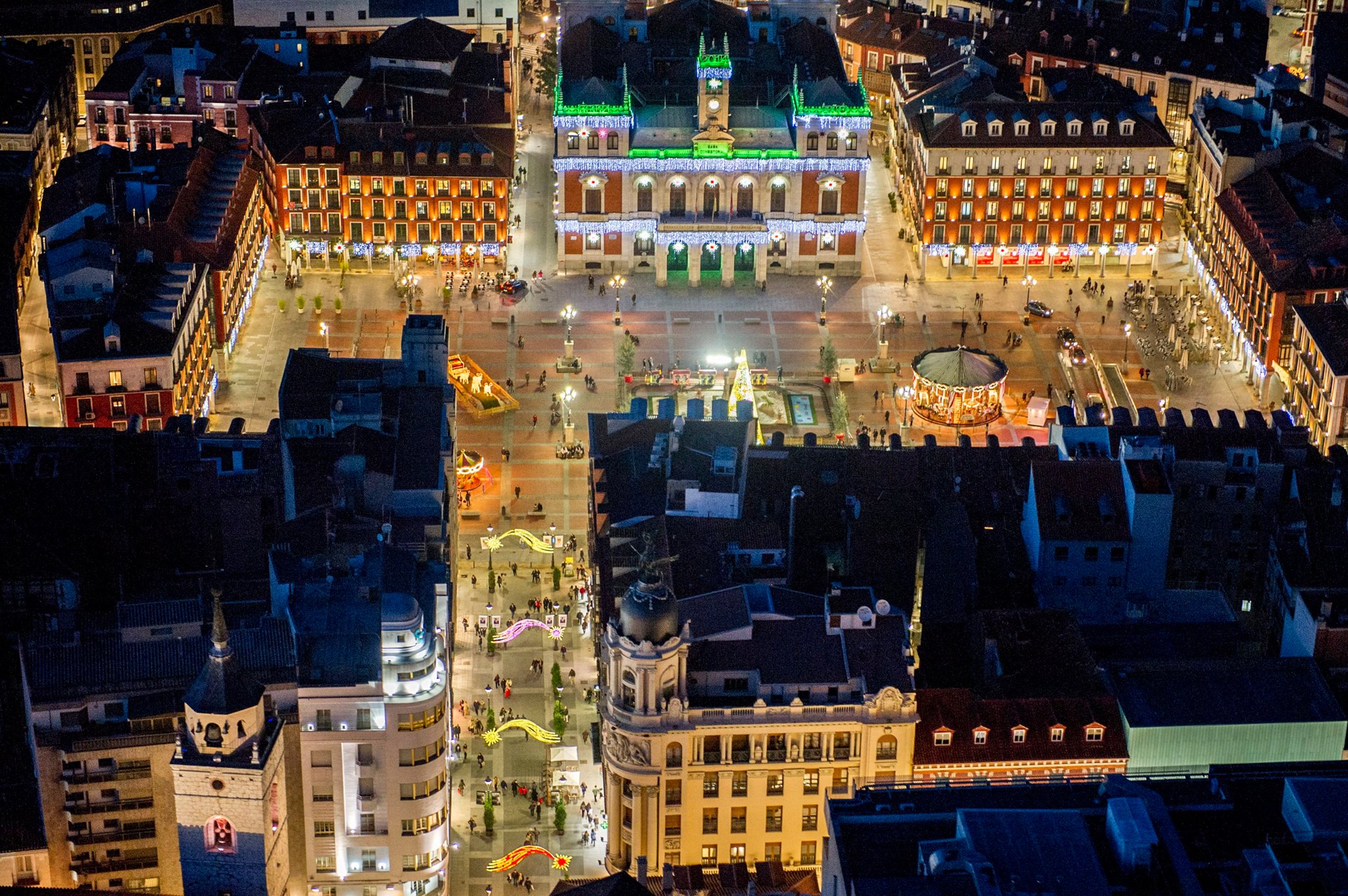
Valladolid, November 2018
Travelling across the great plains of northwestern Spain at dusk, the windows of the bus I’m travelling on reveal vast expanses of space I never knew existed here. You could easily be forgiven if you thought you were in the middle of Texas. Wide open spaces with no lights for miles on end. In fact, Spain is similar to the USA in that you can find almost every type of geography and climate, incredible considering the Iberian nation’s landmass is equal to just 5% of that of the US. The bus rolls on, the classic black silhouette of the large black bull famous across Spain as the historic advertisement for Osborne brandy, rolls past. I feel like I am looking at the vistas from Bigas Luna’s classic film Jamón Jamón, although this time, mixed with the expanses of dry earth are irrigated fields, vineyards, castles, the odd hill and the occasional mountain range in the distance. We are deep in the largest autonomous community of Spain, Castilla y León.
I am travelling with a group of hikers from the orange and green peaks of Las Medulas – mountains which were literally blown apart by the Romans using cascades of water to form the largest open-pit gold mine of the Roman empire – located in the Ponferrada province near León. We are on the way back to my former home, the city of Valladolid.
Even though the land surrounding the city, La Meseta Central, is almost completely flat, spurred occasionally with a large, flat-topped mountain, Valladolid is elevated 735 metres above sea level, although you would never know it. The city is the capital of Castilla y León and the largest city in northwestern Spain. It sits proudly in the middle of five of Spain, and indeed the world’s, great wine growing regions of which the most well known outside of Spain is Ribera del Duero. A mix of romanesque and medieval cathedrals, churches, palaces, patios, plazas, bridges combined with modern industry – Renault has a large factory there for example – characterise this city. Extreme seasons with unforgiving below zero temperatures, freezing winds and up to weeks on end of fog in the winter and intense dry heat in the summer characterise the weather here. A city of opposites.
Valladolid was the birthplace of Philip II, the ruler of the Spanish empire “on which the sun never set” and whose great armada was famously defeated by Elizabeth II. His son, Philip III, made Valladolid the capital city of unified Spain for a rather measly five years between 1601 and 1606. However, the city had been capital of the Crown of Castile – which ruled over the majority of modern Spain – for many, turbulent years between 1469 and 1561. The city is the place of death of hero and villain Christopher Colombus and for many years the city of residence of Miguel de Cervantes. Today, Valladolid is a city of sport with their two rugby clubs the best in Spain and their football club, Real Valladolid, recently promoted to La Liga where they are blossoming, under new ownership from Ronaldo (the great Brazilian number 9, not Cristiano). It is also a city of cinema with Ai Wei Wei one of the guests at the city’s prestigious annual film festival, Seminci, last year. This year Queen Letizia of Spain was in appearance.
Although the local government is currently from the socialist, centre-left PSOE party, many people across Spain, still refer to Valladolid, these days rather unfairly, as “Fachadolid”. The name was acquired in 1981 when an article in a by-gone popular Spanish magazine, Intervíu, spoke of a terrible attack in the city when three young fascists approached a local bar, El largo adios, smashed its windows, threw a molotov cocktail inside – which they forgot to light – and horrifically fired multiple shots from a pistol inside the bar with two bullets hitting Jorge Simón, a young university law student. One bullet lodged in his skull the other was embedded in the fifth vertebra, causing an irreversible paraplegia. Life would never be the same for that poor young man and neither for the image of Valladolid.
***
Valladolid is an interesting city to explore. The centre is clean, neat and tidy. And beautiful. And old. The plaza mayor, or main square – which was the blueprint for Madrid’s famous plaza mayor – is absolutely charming. The city’s bridges, churches, palaces and patios are majestic. At night they are illuminated and their towers and spires shine enchantingly against the night sky.
The people too are just as polished. The citizens venture out in their Sunday best, seemingly everyday. In winter, it is almost comical how many women start wearing fur coats. And, if at least a degree of its conservatism is to be judged on its strong catholic tradition, its Semana Santa, or holy week, processions are amongst the most serious in Spain. Language too is revered in Valladolid. Many citizens will claim it is the birthplace of the original Spanish language, Castellano, and the best and most correct Spanish in the country, however citizens of Salamanca would tell you otherwise. To add to all of this many feel that opposed to the stereotype of southern Spaniards from Andalusia being open and friendly party people, the citizens of Valladolid, known as Valisoletanos or Pucelanos, have a reputation of being the opposite, which is also unfair. They are different. Some are indifferent or colder but in my experience most are open, friendly and courteous people. Either way, with the posh clothes, the strong religious tradition and the pretentiousness over language you can’t help feeling at times that it is a conservative city.
However, it doesn’t take long to discover that the city is also a hive for people of very different outlooks. In some areas you can find the “posher” and arguably more conservative nightclubs and bars and yet in others you can find large areas of day and nightlife strongly patronized by artists, lefties, rockers and anarchists. In the 80s there was also clear opposing areas of bars, one the fascist or national zone, the other the red zone.
Sadly, Valladolid had a history, a violent one, of these opposing sides. In the 1980’s trouble in bars was mainly during student’s demonstrations against education laws by the central PSOE government and, in the 70’s, against Franco. Throughout that period police assaulted many bars and arrested many demonstrators. In the times of Franco, after a government ruling, the University of Valladolid shut down four faculties with 8,000 students forced out. During that time even the university was not off-limits with students and the university library of arts attacked by national police. Even in the mid-1990s the most anti-fascist bar of Valladolid, an anarchist bar called Kaos, was burnt out. It is claimed that people suspected it an attack by fascists, but no evidence was ever found to prove it.
Thankfully, these days, the city is a fun and safe place. People continue to voice their opinions by utilizing peaceful protests, which are fairly common, with topics ranging from support of the Guardia Civil, the army or the state of Spain to others advocating workers rights, better education or an end to bullfighting. Gladly there are no sides when people come together to protest against gender violence and for women’s rights.
One topic which blurred the lines whilst bolstering them at their more extreme end was, and is, Catalonia. The city’s population, and the population of Spain in general, does have a large common majority who are pro-Spain and anti-Catalan independence with Spanish flags being displayed from many apartments across the country following last year’s contentious independence referendum in Catalonia. In Valladolid, there was also a protest in support of the plight of the Catalan independistas the day after the gruesome crack down on voters by the Guardia Civil across Catalonia. I was in attendance, with a friend, Javi. We were not there to support independence but to protest the violence used by the Guardia Civil that sad day.
Javi, a high school social sciences teacher, was my unofficial tour guide and would show me around his city and explain the traditions, history and the financial and cultural disparities of Valladolid and Spain. An intelligent middle aged man and anglophile with a flame for life burning through piercing blue eyes. He was a young man and student in the late 80s and early 90s and I learnt all about the many social movements of Valladolid, the plight of students, the fascist and police attacks previously discussed and of the abuses of Spanish politicians during the 2000s. Each meeting, and tour, would be interspersed with wine and tapas. The best way to explore a city.
***
As the bus rolls back into the city, my eyes wander from the book I am reading back to the window. Families are strolling along the pavement enjoying the evening sun. They are relaxed and happy. Although it has a turbulent history, Valladolid is a good place, with a positive future. There exists a fertile debating ground and coming together of people from different perspectives. For all its possible division the vast majority of people live very peacefully together and continue to blur the lines between the differences of the past. In fact, in general, it is a very safe city. It is rare to see any trouble.
My friends and I leave the bus, say goodbye to our fellow hikers and wonder into town. On the way we pass the tiny entrance to the last remaining fascist bar or “social centre”. El Alcazar, home to the Valladolid chapter of the “Democracia Nacional” far right political party, opens its doors twice a week. The bar displays posters outside telling immigrants to “Behave or leave” and for Spain to “Stop Islamisation”. From an internet search I find photos of the interior, where anti-semitic posters amongst other racist and nationalist posters and flags line the walls. The group’s YouTube channel is full of the same foul poison. The anti-fascist graffiti on the front of the bar is a rather welcome sight to say the least.
***
Valladolid was dealt a great blow when it was branded “Fachadolid” 37 years ago. Some argue the stamp was unfair even then, however we might ask: “how was it unfair?” It’s important to remember that Spain had come out of a long fascist dictatorship just 6 years before. One of those who consistently argued against the negative nickname given to the city was Rodríguez Bolaños, former mayor of the city between 1979 and 1995 who sadly passed away this month. Bolaños – Valladolid’s first socialist mayor in constitutional Spain after Franco and the country’s transitional period – ‘dreamt of a Valladolid cosmopolitan, modern and cultured’. Without doubt he helped the city achieve that status.
Although Valladolid was and is a city of opposing ideals and ideas, labels are created to brand something in that moment, but for good or for bad they can often stick for decades, if not, centuries. For Valladolid, it is time a new label is found for this progressive city where ideas are, in general, tolerated, and people, in general, get on very well. The future for Valladolid, and humans in general, is the acceptance that opposites are ok. They don’t have to be extremes. They certainly don’t need to be fascist or anarchic, nor hateful or violent. Opposites can work together, in peace. Valladolid has taken up the challenge to create a new image, be it city of cinema, of rugby, of illumination, of majestic spires, or of wine. Now all it needs is a new, positive, nickname. And in memory of Rodríguez Bolaños, the people of Spain should support Valladolid and do away with the toxic label “Fachadolid” which only serves to hurt the whole country, not just the city which still receives it.

 The Bowden Report
Great post 😁
An amazing article – very detailed and professional but at the same time heartwarming because it transmits your respect and love for the city. It’s exciting to see how someone else has experienced a place of which I have a million memories of my own. Wish I was still there! All the best for your time en el sur! xx Lisa
Congratulation Alex! Nice report based in the humble and innocent point of view of a foreigner with no prejudices.